In MongoDB each member of a replica set has a state so in this blog we can see about replica set member states & its explanation.
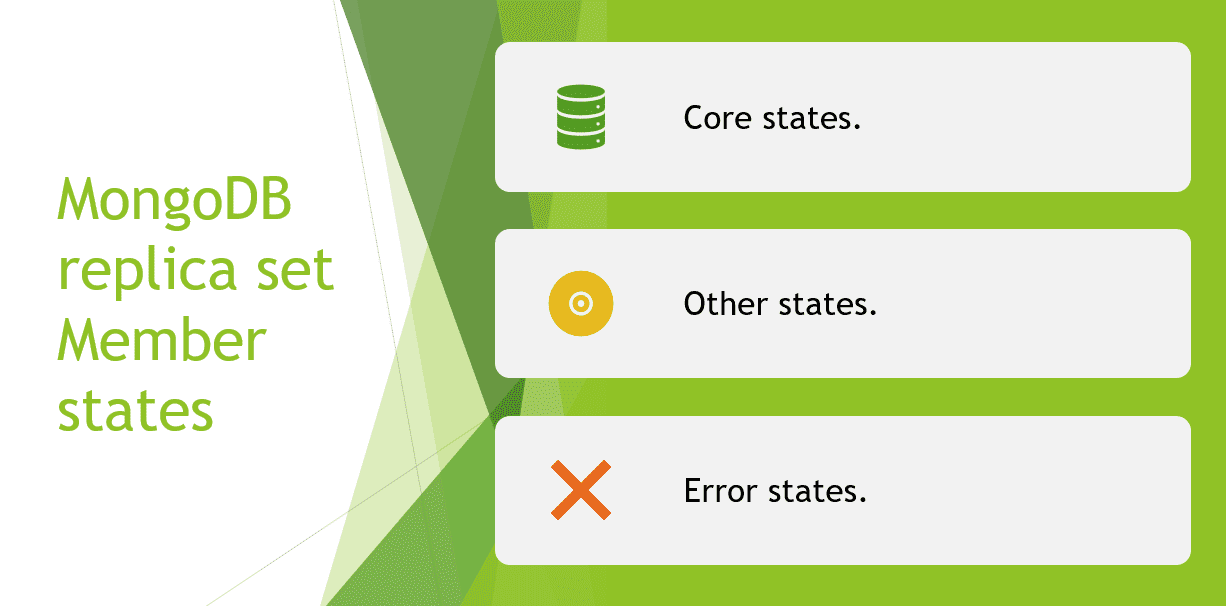
MongoDB replica set has three types of states.
- Core states.
- Other states.
- Error states.
Core states :
In Core states has three members and all are eligible to vote in election.
- PRIMARY.
- SECONDARY.
- ARBITER.
PRIMARY –
- PRIMARY is the only member that can accept write operations.
- A replica set has at most one primary at a time.
SECONDARY –
- SECONDARY state replicate the primary’s data set & can be configured to accept read operations.
- It may be elected to the PRIMARY state if the primary becomes unavailable.
ARBITER –
- ARBITER state do not replicate data or accept write operations.
- Replica sets should only have a member in the ARBITER state and exist solely participate in elections.
Other states :
In Other states has four members and all are eligible to vote in election expect STARTUP.
- STARTUP.
- STARTUP2.
- RECOVERING.
- ROLLBACK.
STARTUP –
- Each member of a replica set start up in STARTUP state.
- They are not yet a recognized member of any replica state.
STARTUP2 –
- It has joined the set and is running an initial sync.
RECOVERING –
- Either it perform startup self-checks or transition from completing a rollback or resync.
- Data is not available for reads.
ROLLBACK –
- The member is actively performing a rollback.
Error states :
In Error states has three members & all are not eligible to vote in election.
- UNKNOWN.
- DOWN.
- REMOVED.
UNKNOWN –
- Members that have never communicated status information to the replica set.
DOWN –
- Members that lose their connection to the replica set & it’s an unreachable mode.
REMOVED –
- Members that are removed from the replica set.
I hope this blog will help you find out MongoDB replica set member states.
Thank you !!
 Arun kumar Rajendran Database blog